

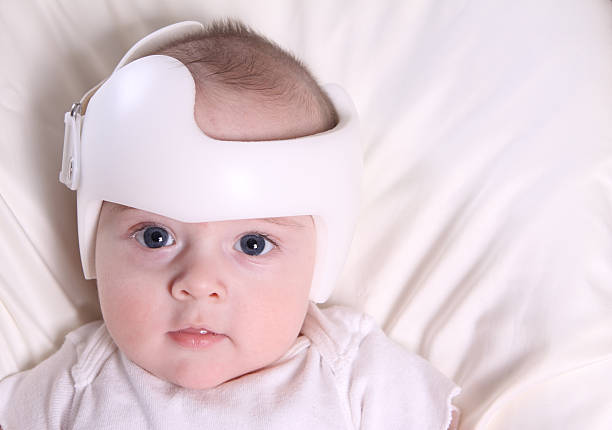
Infant wearing a helmet or band for treatment of plagiocephaly (misshapen head)SEE ALSO:
As a new parent, you spend countless hours watching your baby sleep, grow, and reach exciting milestones. During those quiet moments, it is natural to notice every small change, including the shape of your baby’s head. Sometimes parents observe a flat spot on the back or side of the head that does not seem to improve over time. While repositioning and tummy time can often help in the early stages, certain cases require additional support to guide healthy skull development.
Terms such as plagiocephaly and brachycephaly can sound intimidating when you first hear them, but these conditions are relatively common and treatable. Cranial asymmetry can develop for a variety of reasons, including sleep positioning, limited neck movement, or pressure on the skull during early development. Because an infant’s skull is still soft and growing rapidly, early evaluation plays an important role in determining the best course of action.
For families in Farmingdale, Long Island, and the surrounding New York area, professional guidance can make a significant difference in navigating this process. At Prothotic Laboratories, parents receive compassionate support combined with advanced medical technology to evaluate and treat head shape concerns. With state-of-the-art 3D cranial scanning and expert clinical care, the team helps determine whether a cranial remolding helmet in Farmingdale, NY is the right option for a child’s development.
Understanding Cranial Asymmetry in Infants
During the first year of life, a baby’s skull is designed to be flexible so it can grow quickly alongside brain development. This flexibility allows the skull bones to shift slightly when pressure is applied repeatedly to one area. While this natural feature supports healthy growth, it can also lead to visible head shape changes if pressure is not evenly distributed.
One of the most common conditions parents encounter is plagiocephaly, which causes flattening on one side of the back of the head. When viewed from above, the head may appear slightly uneven or asymmetrical. Another condition, brachycephaly, causes flattening across the entire back of the head, resulting in a wider appearance from side to side.
Understanding the difference between brachycephaly vs. plagiocephaly helps parents and clinicians determine the most appropriate treatment approach. Both conditions fall under the broader category of cranial asymmetry, and each may require different types of monitoring or intervention depending on severity.
In many cases, pediatricians first recommend repositioning techniques and supervised tummy time to relieve pressure on the affected areas. However, if the head shape does not improve over time, a specialist may recommend further evaluation to determine whether infant plagiocephaly treatment involving a custom orthotic device would be beneficial.
Prothotic Laboratories provides comprehensive assessments to help families understand their child’s specific condition and the available treatment options.
Recognizing Early Signs That May Require Intervention
Parents are often the first to notice subtle changes in their baby’s head shape. These observations can play an important role in identifying potential concerns early. While some flattening may resolve naturally as a baby becomes more mobile, persistent asymmetry may indicate the need for professional evaluation.
A flat spot on one side or across the back of the head is one of the most common early signs. In some cases, parents may also notice that one ear appears slightly farther forward than the other, or that the forehead looks more prominent on one side.
Another sign involves difficulty turning the head evenly from side to side. Some babies develop a preference for sleeping or resting with their head in the same position, which increases pressure on one area of the skull.
When these signs persist despite repositioning efforts, clinicians may recommend further evaluation through advanced imaging techniques. At Prothotic Laboratories, 3D cranial scanning provides a precise way to measure head shape and identify the degree of asymmetry.
This technology eliminates the need for messy plaster casts that were once used to create molds. Instead, a quick and comfortable scan captures detailed measurements that allow specialists to evaluate cranial development accurately. For many parents exploring custom baby helmets in Long Island, this modern approach offers reassurance that their child’s comfort remains a top priority.
The Window of Opportunity for Effective Treatment
Timing plays a crucial role in achieving successful outcomes with cranial remolding therapy. During the first year of life, an infant’s skull grows rapidly, making it possible to gently guide the shape as the brain develops.
The optimal window for treatment typically falls between 4 and 12 months of age. During this period, the skull bones are still flexible enough to respond effectively to corrective guidance. If treatment begins later, the skull gradually becomes less adaptable, which may limit the effectiveness of certain interventions.
A cranial remolding helmet works by providing gentle guidance to areas where growth is needed while allowing room for expansion where the skull needs to round out. The helmet does not squeeze or force the head into shape. Instead, it directs natural growth into the areas that require correction.
For families considering a cranial remolding helmet in Farmingdale, NY, understanding this timeline helps ensure that treatment begins at the most beneficial stage. Early evaluation allows clinicians to determine whether a helmet is necessary or whether repositioning and physical therapy may be sufficient.
At Prothotic Laboratories, specialists work closely with pediatricians and therapists throughout Long Island and the Five Boroughs to ensure that infants receive timely assessments during this important developmental stage.
Precision Customization Through Advanced Fabrication
Every baby’s head shape is unique, which is why effective treatment requires a truly customized solution. Custom baby helmets in Long Island are carefully designed based on the detailed measurements captured during 3D cranial scanning.
Because Prothotic Laboratories operates as a full-service custom orthotic lab in New York, the team has direct oversight of the entire fabrication process. This hands-on approach ensures that each cranial helmet is not simply a generic device but a precision-engineered medical tool tailored to the infant’s exact measurements.
The fabrication process begins with analyzing the 3D scan data to determine how the helmet should guide future skull growth. Technicians then construct the helmet using lightweight medical-grade materials designed to keep the baby comfortable throughout daily wear.
Certified clinical expertise is a key component of this process. The practitioners at Prothotic Laboratories hold ABC certification, which represents the highest level of credentialing in the orthotic and prosthetic industry. This certification demonstrates advanced training and adherence to strict professional standards.
For parents navigating decisions about infant plagiocephaly treatment, working with certified specialists provides reassurance that their child’s care is guided by experienced professionals who prioritize both safety and effectiveness.
Ongoing Care and the Helmet Adjustment Process
Cranial remolding therapy is not a one-time procedure. Because infants grow quickly during the first year of life, the helmet must be adjusted regularly to remain effective and comfortable.
At Prothotic Laboratories, the helmet adjustment process is an integral part of what families often describe as the Prothotic Experience. During scheduled follow-up visits, clinicians evaluate the baby’s growth and make precise modifications to the helmet’s interior shape.
These adjustments ensure that the helmet continues guiding head growth in the desired direction while maintaining a comfortable fit. The frequency of visits varies depending on the child’s growth rate and the severity of the initial asymmetry.
Parents often find reassurance in these regular check-ins, as they provide an opportunity to track progress and address any concerns that may arise. The collaborative approach also allows clinicians to celebrate milestones alongside families as improvements in head shape become visible.
For pediatricians and physical therapists in the New York area, having a reliable referral partner for porthotic solutions for infants can be invaluable. Prothotic Laboratories works closely with healthcare providers to ensure that every child receives coordinated care throughout the treatment process.
Cranial asymmetry can feel overwhelming when parents first notice it, but early evaluation and modern treatment options offer encouraging solutions. Through advanced technology, compassionate care, and decades of clinical experience, Prothotic Laboratories continues to help families in Farmingdale and throughout Long Island guide healthy head shape development during the most important stages of infancy.