

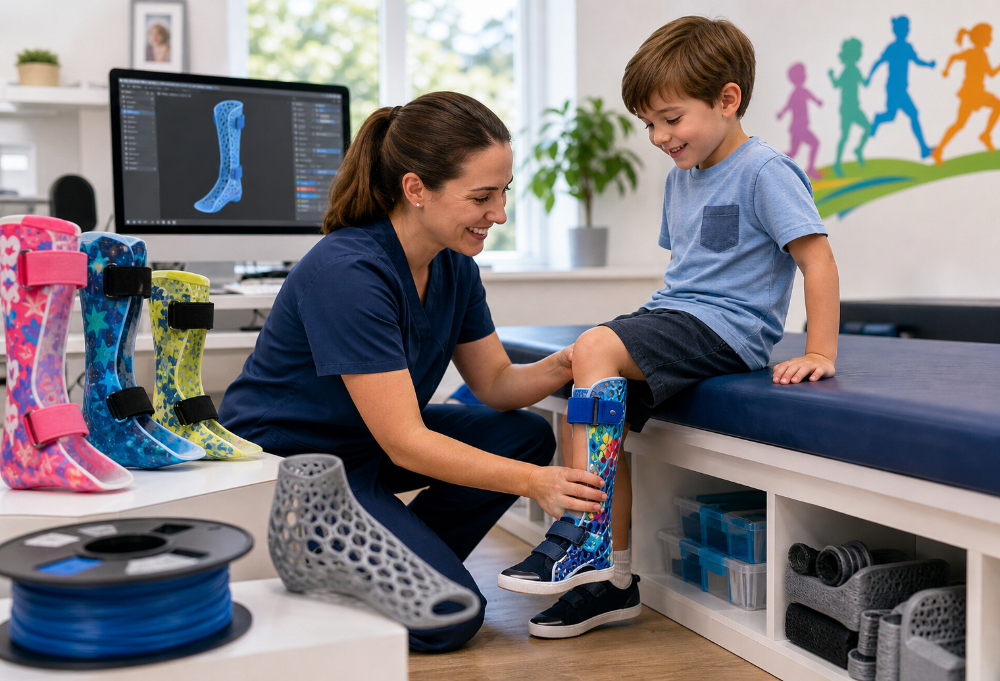
For families navigating the world of pediatric orthotics, the arrival of 3D printing technology has been nothing short of transformative. Children who struggle with mobility challenges, whether due to cerebral palsy, spina bifida, muscular dystrophy, or other neurological and orthopedic conditions, have historically faced a long and sometimes frustrating road when it comes to getting properly fitted braces. Today, advances in additive manufacturing are changing that experience in meaningful ways.
From custom leg braces for kids in NY to specialized clinics in Farmingdale, more families are discovering how 3D printed solutions can improve both outcomes and quality of life.
The Traditional Challenges of Pediatric Orthotics
Before appreciating what 3D printing brings to the table, it helps to understand what conventional orthotics involved. Traditional ankle-foot orthoses (AFOs) and other braces were fabricated using plaster casting, manual trimming, and labor-intensive fitting processes. The results were often bulky, heavy, and uncomfortable, especially for young children who are still growing rapidly. Parents frequently returned to clinics for adjustments, replacements, and modifications as their child’s body changed.
Children wearing ill-fitting braces were more likely to resist wearing them altogether, which in turn slowed down progress in pediatric gait correction. The discomfort was not just physical. Many children, particularly school-age kids, felt self-conscious about large, conspicuous devices strapped to their legs. Compliance was a persistent issue, and without consistent wear, therapeutic goals were harder to achieve.
How 3D Printing Transforms the Custom Brace Experience
The introduction of 3D printed pediatric AFO technology has addressed many of these pain points directly. The process typically begins with a digital scan of the child’s limb, which captures precise measurements and contours that a plaster mold simply cannot match in terms of accuracy. That digital model is then used to design and print a brace that fits the child’s anatomy exactly.
This level of customization is one of the most significant advantages. No two children are alike, and their orthotics should not be either. With digital fabrication, clinicians can fine-tune designs to accommodate specific gait abnormalities, pressure points, and functional needs without adding unnecessary bulk. Custom braces are designed with the child’s lifestyle in mind, which means they can be made thinner, more flexible where appropriate, and better suited to fitting inside regular shoes.
For families seeking custom leg braces for kids in NY or those based in Farmingdale and surrounding areas, finding a provider who has embraced this technology means access to a higher standard of care. The design process also allows for aesthetic personalization, letting children choose colors or patterns that make them feel proud of their device rather than embarrassed by it. This seemingly small detail has a measurable impact on how consistently children wear their braces.
The Role of Lightweight Orthotics in Improving Mobility and Comfort
One of the most frequently cited advantages among both clinicians and families is the reduced weight of 3D printed devices. Lightweight orthotics for children are not just more comfortable; they are functionally superior in many cases. When a brace is heavy, it adds resistance to every step, which can cause fatigue, alter natural movement patterns, and discourage activity.
Children are naturally energetic. They run, climb, and play, and their orthotics need to keep up. A 3D printed brace, depending on the materials used, can be significantly lighter than a traditionally fabricated device while maintaining or even exceeding its structural integrity. Materials such as thermoplastic polyurethane, nylon composites, and carbon fiber-infused filaments allow for strong yet lightweight constructions that flex in the right places and hold firm where support is needed.
This matters enormously for pediatric gait correction. When a child can move more naturally and with less physical resistance from their device, they are more likely to develop the muscle patterns and motor habits that support long-term functional improvement. Physical therapists working alongside orthotists can design progressive programs that are more effective when the brace itself is not an obstacle.
Reduced weight also translates directly into reduced fatigue at the end of a school day, during physical education, or through after-school activities. Children who feel less worn down by their devices are more engaged, more active, and more willing to participate fully in their daily routines.
Faster Turnaround and Easier Adjustments for Growing Children
Children grow quickly, and that growth creates a unique challenge in the world of orthotics. A brace that fits perfectly in January may be too small by April. Traditional fabrication methods meant that a new fitting, new casting, and new production cycle had to begin each time a significant change occurred. That process could take weeks, leaving a child without proper support during the gap.
3D printing significantly shortens that cycle. Because the child’s digital measurements are stored and can be modified in software, producing a new version of the brace becomes a much faster process. Clinicians can adjust the digital file to account for growth and print an updated device in a fraction of the time it would take using conventional methods. For families in Farmingdale and across NY, this means fewer disruptions to a child’s care routine and fewer periods of going without a well-fitted device.
This speed also allows for more iterative refinement. If a child reports discomfort in a specific area after a week of wear, a clinician can adjust the model and reprint a corrected version relatively quickly. That kind of responsiveness was much harder to achieve with traditional fabrication, where any modification required physical rework and often added significant time to the process.
For parents, this means less waiting, fewer missed school days for clinic visits, and greater peace of mind knowing that their child’s care can adapt as quickly as their child does.
Supporting Pediatric Gait Correction Through Precision Engineering
At the heart of why 3D printed custom braces represent such a leap forward is the concept of precision. Pediatric gait correction is not a one-size-fits-all endeavor. Every child presents a unique combination of muscle tone, joint range of motion, neurological function, and compensatory movement patterns. Getting the orthotic intervention right requires a device that can be engineered to exact specifications.
Digital design tools used in 3D printed pediatric AFO development allow clinicians and orthotists to simulate how a brace will interact with a child’s gait cycle before it is ever printed. They can model the stiffness gradient along the shaft of the AFO, control the trim lines to affect specific joints, and even adjust the heel cup geometry to influence ground reaction forces. These are variables that traditional hand fabrication struggled to control with the same level of consistency.
For children in specialized care programs, particularly those in urban and suburban centers like NY and Farmingdale, this precision means that every element of the brace is purposefully designed. There is no guesswork, no excess material added just in case, and no compromise between what the child needs and what the fabrication process could deliver.
Clinicians are able to collaborate more effectively with other members of a child’s care team, including physical therapists, physiatrists, and developmental pediatricians, because the digital design files provide a clear and shareable record of exactly what was created and why.
Conclusion
The shift toward 3D printed orthotics represents more than a technological upgrade. It is a meaningful improvement in how children with mobility challenges experience their care. From lighter, more comfortable devices to faster adjustments and more precise support for pediatric gait correction, the benefits are practical, measurable, and child-centered. For families exploring custom leg braces for kids in NY, including those in Farmingdale and nearby communities, speaking with an orthotist who specializes in 3D printed pediatric AFO technology is a step worth taking.
Need a Prosthetic and Orthotic Laboratory Near You?
Prothotic Labratories, Inc. is a family-owned and -operated prosthetics and orthotics specialist based in Farmingdale, New York since 1988. We offer the highest quality of products, services, and patient care for all of your prosthetic and orthotic management needs. We specialize in pediatric prosthetics, but also offer adult products and services as well, such as scoliosis management, creating custom-designed prosthetics for the upper or lower extremities, and much more. We also have extensive experience in the orthotic management of cerebral palsy, arthrogryposis, osteogenesis imperfecta, spinal muscular atrophy, and neuromuscular and idiopathic scoliosis. Give us a call today, or visit us for more information!