

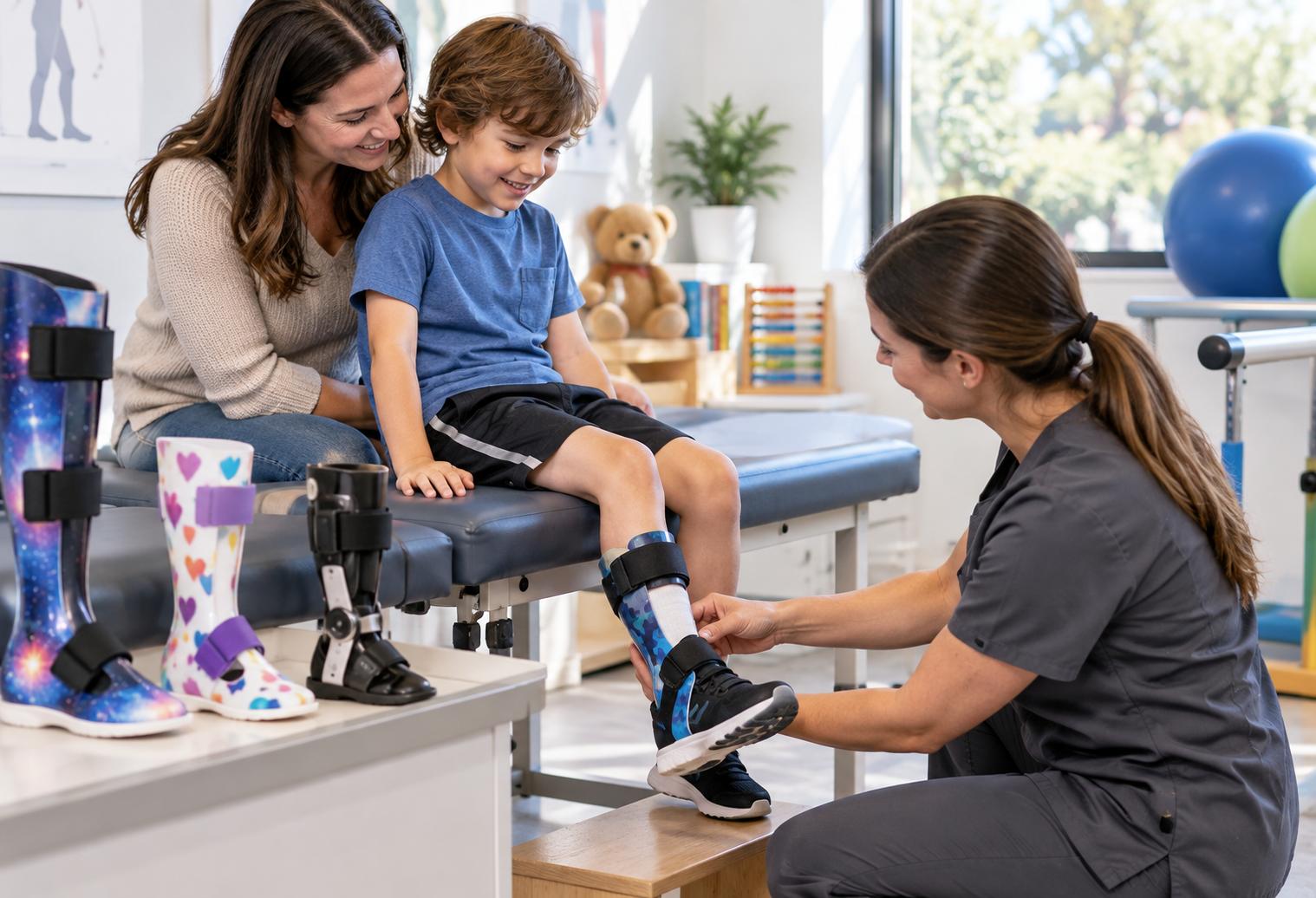
When a child is prescribed a lower extremity brace, parents often have questions about what the device does, how it should fit, and what daily life will look like once their child begins wearing it. For families on Long Island, understanding the purpose of a custom orthosis can make appointments, school routines, therapy, and follow-up care easier to navigate.
Quick answer: Custom pediatric lower extremity orthotics are braces designed to support a child’s legs, ankles, or feet based on their individual needs. An AFO, or ankle-foot orthosis, supports the foot and ankle, while braces extending higher on the leg may also address knee stability or positioning. The exact design should be based on the child’s diagnosis, physical examination, mobility goals, and prescription from their healthcare provider.
What Long Island parents should know
-
An AFO supports the foot and ankle and may be prescribed to improve positioning, stability, or walking mechanics.
-
Orthotic needs can change as children grow, so families from Nassau County and Suffolk County should expect periodic fit checks and possible replacement.
-
Some children need a brace that extends above the knee when support at the ankle alone is not enough.
-
Redness, pain, pressure areas, or a sudden change in how a child walks should be discussed with the child’s healthcare or orthotic team.
-
The right brace depends on the individual child, so another child’s AFO or lower extremity orthosis is not a useful model for what your child should wear.
What Are Pediatric AFOs and KFOs?
Pediatric AFOs and KFOs are lower extremity orthoses designed to support specific joints, control movement, improve alignment, or assist a child with standing and walking. The appropriate device depends on which parts of the lower extremity require support and what the prescribing medical team is trying to accomplish.
AFO stands for ankle-foot orthosis. OrthoKids, an educational resource of the Pediatric Orthopaedic Society of North America, describes an AFO as a brace that supports the foot and ankle and may help stabilize the ankle or influence how a child walks.
Parents may also encounter terminology for orthoses extending above the knee. The commonly used term KAFO means knee-ankle-foot orthosis and describes a longer brace incorporating the knee, ankle, and foot. Johns Hopkins Medicine identifies a KAFO as a knee-ankle-foot orthosis, sometimes called a long-leg brace.
If your child’s paperwork or provider uses the term KFO, ask exactly which joints the prescribed device is intended to support. Orthotic terminology can vary, and understanding the prescribed design is more useful than relying on an abbreviation alone.
Why Do Children Need Lower Extremity Orthotics?
Children may need lower extremity orthotics when additional support, positioning, stability, or movement control can help them stand, walk, or participate more effectively in daily activities. A brace is selected for a specific functional reason rather than simply because a child’s feet or legs look different.
Depending on the diagnosis, an AFO may be considered for concerns involving ankle weakness, foot position, toe walking, or certain neuromuscular conditions. Johns Hopkins Medicine notes that some children who toe walk may benefit from an AFO that encourages a flatter foot position during walking.
For families traveling between communities such as Garden City, Hicksville, Huntington, Smithtown, and surrounding areas, the goal is the same: the orthosis should address the child’s individual functional needs while fitting into everyday routines at home, school, therapy, and recreation.
Why Does a Custom Fit Matter for Growing Children?
A custom fit matters because a pediatric orthosis must match a child’s anatomy closely enough to provide the intended support without creating unnecessary pressure or interfering with movement. Growth can change that relationship, which makes ongoing fit evaluation especially important in pediatric care.
OrthoKids notes that custom AFOs will likely need replacement as a child’s feet grow. Children can also experience changes in height, leg shape, muscle tone, range of motion, and activity level.
At Prothotic Laboratories, Inc., we understand that parents are not simply looking at a brace in isolation. They are thinking about shoes, school, therapy sessions, transportation, playground time, and how the device fits into family life across Long Island.
What Should Parents Expect During the Orthotic Process?
The pediatric orthotic process generally involves reviewing the prescription, evaluating the child, determining an appropriate orthotic design, fitting the device, and checking how the child responds once it is being worn. Follow-up is important because comfort and function cannot always be judged from appearance alone.
The exact process varies according to the prescription and the child’s needs. A parent may be asked about mobility, daily activities, shoes, therapy, previous braces, areas of sensitivity, and changes they have observed.
Families coming from Nassau County, Suffolk County, or communities near the Nassau-Suffolk border can help by bringing relevant instructions from the prescribing provider and any shoes specifically intended to be worn with the orthosis.
What Warning Signs Can Suggest an Orthosis Needs Attention?
An orthosis may need professional attention when a child develops persistent skin irritation, pain, pressure, fit problems, damage to the brace, or noticeable changes in walking while wearing it. Parents should pay attention to new problems rather than assuming discomfort is simply part of getting used to a brace.
Watch for:
-
Redness that does not resolve as expected after removing the orthosis.
-
Blisters, sores, broken skin, or unusual pressure marks.
-
Complaints of pain or significant discomfort.
-
Toes appearing unusually crowded or extending beyond the expected position.
-
Straps that no longer secure the brace appropriately.
-
Cracks, sharp edges, or broken components.
-
A noticeable change in balance, walking pattern, or willingness to wear the device.
-
A brace that appears increasingly difficult to put on as the child grows.
Children’s Hospital Boston advises families using AFOs to monitor the skin and contact the child’s healthcare team when redness persists, pain occurs, or the device is damaged.
When Should Long Island Parents Call a Professional?
Parents should contact the appropriate healthcare or orthotic professional when an orthosis causes persistent discomfort, appears too small, becomes damaged, creates skin problems, or no longer seems to support the child as intended. Adjusting a prescribed brace at home can change how it functions and should generally be avoided.
Parents can safely observe skin condition, strap placement, shoe fit, and their child’s comfort according to instructions from the care team. Structural modifications, heating or reshaping plastic, trimming components, or changing the prescribed alignment should be left to a qualified professional.
Because children grow quickly, a brace that worked well earlier in the school year may require reassessment later. This can be especially relevant for active children moving between school, therapy, sports, and family activities throughout Long Island.
What Are Common Causes of Pediatric Orthotic Fit Changes?
Pediatric orthotic fit commonly changes because children grow, their physical abilities change, their treatment goals evolve, or the orthosis experiences normal wear from regular use. A change in fit does not automatically mean something is wrong with the original device.
Common reasons include growth of the foot or leg, changes in muscle tone or range of motion, new footwear, increased activity, changes following therapy or medical treatment, and wear to straps or other components.
For local families balancing appointments from places such as Mineola, Massapequa, Commack, and Patchogue, keeping track of these changes can make follow-up visits more productive.
How Can Parents Care for a Child’s Orthosis?
Parents can help an orthosis function as intended by following the prescribed wear schedule, checking the child’s skin, keeping the device clean according to care instructions, and reporting changes promptly. The child’s medical and orthotic team should provide instructions specific to the device.
Do not assume that a wear schedule found online applies to your child. Some children may build up wearing time gradually, while others have different instructions based on their diagnosis or treatment plan.
Also inspect shoes regularly. An AFO typically occupies additional space inside footwear, so proper shoe fit is an important part of the overall setup.
What Results Should Parents Expect From Pediatric Orthotics?
Parents should expect a pediatric orthosis to address the specific functional goals established by the child’s care team, rather than to produce the same result for every child. Those goals may involve stability, alignment, positioning, walking mechanics, protection, or support during particular activities.
Progress may also involve therapy, medical follow-up, home exercises, or other treatments. An orthosis is often one part of a broader care plan.
Parents throughout Long Island should ask their child’s provider what success should look like in their particular situation and how progress will be evaluated over time.
What Common Orthotic Mistakes Should Parents Avoid?
The most common orthotic mistakes involve changing the brace without professional guidance, overlooking fit changes, or comparing one child’s prescription with another child’s device. A custom pediatric orthosis is designed around an individual child and should be managed that way.
Mistake: Continuing to use a visibly outgrown brace.
Consequence: Fit and pressure can change as the child grows.
Better approach: Arrange a professional fit assessment when growth becomes noticeable.
Mistake: Modifying rigid components at home.
Consequence: The change may alter the device’s intended function.
Better approach: Have needed adjustments evaluated professionally.
Mistake: Ignoring skin irritation because the child is “still getting used to it.”
Consequence: Persistent pressure can become a larger skin problem.
Better approach: Follow the skin-check instructions provided by the care team and report concerning areas.
A Common Long Island Family Scenario
A common local scenario is a child who receives a new AFO and initially does well, but several months later begins complaining that the brace feels tight inside the same shoes. The parent may also notice new pressure marks or that fastening the straps takes more effort.
This does not identify a specific diagnosis or automatically mean a new device is required. It does mean the fit is worth evaluating. Growing children can change rapidly, and a professional assessment can determine whether an adjustment, footwear change, or replacement should be discussed.
What Pediatric Orthotic Solutions May Be Considered?
Pediatric orthotic solutions may range from devices supporting the foot and ankle to longer lower extremity orthoses that also provide support around the knee. The correct option should follow the child’s prescription and the clinical goals established by the healthcare team.
We can help families understand the fabrication and fitting process for custom pediatric lower extremity orthotics and address practical questions about fit, use, and follow-up.
How Do AFOs and Longer Leg Braces Compare?
AFOs primarily address the ankle and foot, while longer lower extremity braces may incorporate the knee when additional support or control is prescribed. Neither option is inherently better because each device addresses different clinical needs.
An AFO may be appropriate when the treatment goal centers on the ankle and foot. A KAFO extends above the knee and may be prescribed when knee support or control is also needed. Parents should rely on their child’s prescribing provider to determine which joints need to be included in the orthosis.
What Areas Do We Serve?
We provide an orthotic resource for families seeking pediatric lower extremity solutions on Long Island, including communities across Nassau and Suffolk counties. Parents may travel from nearby towns and surrounding communities based on their child’s medical and orthotic care needs.
For specific service-area availability or appointment information, contact us directly.
What Can Happen If an Outgrown or Poorly Fitting Orthosis Is Ignored?
Continuing to use an orthosis that causes pain, persistent pressure, or significant fit problems can interfere with comfort and may prevent the device from functioning as intended. Waiting is especially unhelpful when a growing child is already showing clear signs that something has changed.
Prompt evaluation allows the care team to determine what is actually causing the problem rather than relying on guesswork at home.
Frequently Asked Questions About Pediatric Orthotics on Long Island
How often should a child’s AFO be replaced?
There is no universal replacement schedule because children grow at different rates and orthotic needs vary. AFOs may require replacement as a child grows or as clinical needs change. Parents should watch for fit changes and follow the review schedule recommended by their child’s healthcare and orthotic team.
Can my child wear regular shoes with an AFO?
Many AFOs are designed to be worn with shoes, but the shoe must provide enough room for both the child’s foot and the orthosis. Parents should follow specific footwear guidance from their orthotic team rather than simply buying a much larger shoe, which can create other fit problems.
Where can Nassau County parents go if an AFO seems too tight?
Nassau County parents should contact their child’s orthotic or healthcare provider when an AFO appears too tight, causes persistent redness, or becomes painful. Do not heat, cut, or reshape the brace at home. A professional can evaluate whether an adjustment, different footwear, or replacement is appropriate.
Do children need a new orthosis every time they have a growth spurt?
Not necessarily, because the need for replacement depends on how growth affects fit and function. Some changes can potentially be addressed through professional adjustment, while other growth changes require a new device. Children wearing braces should have fit concerns evaluated rather than relying on age or elapsed time alone.
Can a pediatric AFO help with toe walking?
An AFO may be part of treatment for some children who toe walk, but it is not appropriate for every child or every cause of toe walking. Johns Hopkins Medicine notes that AFO bracing may be used to encourage a flatter foot position in selected children. Evaluation is important because toe walking has different possible causes.
Should Suffolk County families bring shoes to an orthotic appointment?
Bringing the shoes a child commonly wears can be helpful when footwear compatibility needs to be evaluated. Because many AFOs are worn inside a shoe, the brace, foot, sock, and footwear need to work together. Follow any specific preparation instructions provided before your child’s appointment.
Is an AFO the same as a KAFO?
No. An AFO supports the ankle and foot, while a KAFO includes the knee, ankle, and foot. Which device is prescribed depends on the joints requiring support and the child’s functional goals. Parents who see different abbreviations on paperwork should ask the prescribing team to clarify the exact orthosis ordered.
Is redness normal after removing a pediatric orthosis?
Brief skin color changes may occur with brace wear, but persistent redness, pain, blistering, or broken skin warrants attention. Follow the skin-monitoring instructions given by your child’s care team. Children’s Hospital Boston specifically advises contacting the care team when AFO-related redness does not resolve or when new skin problems develop.
Help Your Child Get the Support Their Orthosis Is Designed to Provide
A pediatric orthosis should fit the child who is wearing it, support clearly defined goals, and be reassessed as that child grows and changes. For families across Long Island, understanding what to watch for can make orthotic care easier to manage from the first fitting through future follow-up.
Get Answers About Custom Pediatric Orthotics on Long Island
We help parents better understand custom lower extremity orthotic options and the fitting process while working within the care plan established for their child.